Five tests to assess your firm’s intersubjective reality…
The week before writing this, OpenAI reportedly told backers to expect annualised revenue approaching $50 billion, far short of the $70 billion reported earlier. As a result Nvidia and other AI-exposed stocks dropped. A week before, Bain & Co had calculated that the AI industry needs $6 trillion in annual revenue by 2031 to justify the data centre spending. By the next day, futures were rising again as fresh AI spending updates eased concerns.
Bubble or not, nothing physical changed between those days. The chips, the models and the data centres were all the same. What moved was a shared belief about what they are worth. This is how markets work - but it shows something fundamental that you need to think about in your business, whatever it is.
I've just been listening to the book Nexus by Yuval Noah Harari (the Sapiens author) and he has a name for that kind of thing. It is about something pretty big: the nature of reality itself.
Three kinds of reality
Harari distinguishes three kinds of reality:
• Objective reality exists whether or not anyone believes in it. A mountain. A virus. A chair.
• Subjective reality exists only in one person's mind. A headache. A dream. Pain.
• Intersubjective reality exists in the shared minds of many people who communicate with each other. Money. Nations. Laws. Religions. Corporations. Your business.
Intersubjective reality is the one that matters most to you. It is the most powerful of the three, because it is what allows millions of strangers to cooperate. A banknote is a piece of paper and a company is a legal fiction. Both are enormously powerful because enough people believe the same story and act on it. And because it lives in people's heads, it can strengthen, fragment or collapse when the belief changes.
Your firm is an intersubjective reality. Strip away the story and you have a lease, some contracts, maybe some production facilities and people who could all work elsewhere. What makes it a firm is that employees, clients, partners and investors share an understanding of what it is for.
The AI market is that principle at a global scale, with trillions of dollars resting on a collective story about the future. An even better example is much cryptocurrency: based entirely on a shared belief that it has value. When the story changes, the value follows.
That is what I mean by strategic narrative: your core story, setting out your mission, how you create value, and what makes you special, different and great. It is the working version of your firm's intersubjective reality.
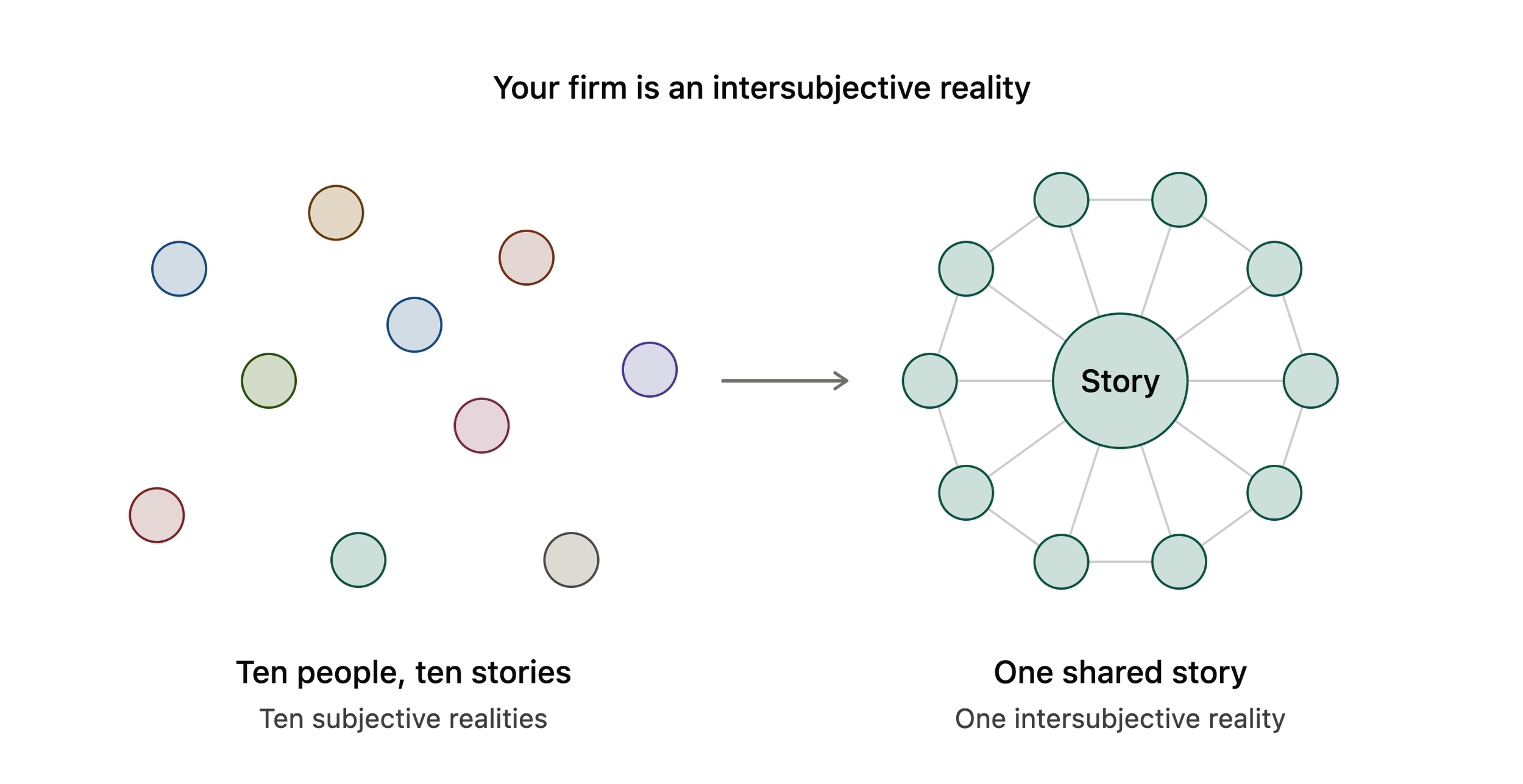
So the real question for any leader is this: how strong is that shared reality?
Five tests of your intersubjective reality
1. How clear is your story? Can you state what your firm is for, how it creates value, who for and why it matters in a few sentences, with no jargon? If leadership can't, nobody downstream can. A vague story is a weak shared reality, and weak realities don't survive pressure.
2. Can all your people tell the same story? Ask ten people across the firm, from partners to new joiners to delivery teams, why it exists and what makes it distinctive. Ten different answers means you don't have one intersubjective reality. You have ten subjective ones, and your clients will meet all of them. Sales and delivery leaders feel this first: when the pitch and the experience tell different stories, belief erodes. When a leadership team have different versions of the truth they point in different directions, all thinking they are doing the right thing.
3. How distinctive is it? Swap your name for a competitor's. If your story still reads true, it isn't distinctive and therefore isn't doing the work. Technology and professional services markets are crowded with near-identical claims. A story that could belong to anyone gives clients no reason to choose you, and it is easily displaced by someone else's.
4. What story are your clients telling about you? This is the hardest test, because the reality is shared and you don't control it. Ask a dozen of your best clients, and some who left, how they would describe you to a peer. Compare it to the story you think you're telling. The client's version is the one that exists in the market, and any gap between it and yours is where your pricing power and pipeline are at risk. Often the gap is in the way value is described by them as opposed to the services you talk about.
5. Does your story stay consistent while the world changes? When technology, markets and client expectations shift in weeks rather than years, people look for something steady to hold onto. A clear, consistent story gives them that. It builds trust and confidence in your firm and in its reason to exist, because clients, employees and investors can see what you stand for even when the details of what you sell are moving.
Consistency doesn't mean rigidity. The core, meaning your purpose, how you create value and what makes you different, stays fixed, while how you express and apply it adapts. Firms that rewrite their story with every new trend teach the market that nothing about them is solid. Firms that never update how it applies look out of touch. The skill is knowing which parts of the story are anchors and which are sails.
What to do this quarter, ready for 2027
• Firm and company leaders: make the narrative a leadership responsibility, owned at the top rather than delegated to marketing. Define which parts of your story are fixed anchors, and say so.
• Sales and value delivery leaders: run the client-story test, and make sure what you promise and what you deliver tell the same story, quarter after quarter. Ensure your teams all know and understand the Strategic Narrative and can apply it with your clients.
• Business unit leaders: write your unit's story in three sentences, check it sits inside the firm's, and test whether your own team can repeat it. It should be like a Russian doll: the wider firm's, your business unit's and the individual people or products' stories should fit within each other.
The firms that hold steady when belief gets nervous won't be the ones with the loudest story. They will be the ones whose story is clear, shared, distinctive, recognised by their clients and consistent enough to trust.
Your move
Don't wait for a bad week to find out. This week, ask five people in your firm to tell you why it exists and what makes it different. Then ask three clients the same question. If the answers don't match, you've found your most urgent strategic problem, and it is one you can fix.
If this resonates, then get in touch to have an open chat about how to ensure you have a powerful Strategic Narrative in 2027.